
How can you introduce children to new flavours without too much difficulty? An unfamiliar colour, smell or texture can be enough for a child to reject a food before even tasting it. Instead of persuading them, try introducing new foods through play, where tasting becomes interesting and exploratory.
The “Flavour Detectives” game encourages children to observe, touch, smell and describe food without the pressure of having to eat everything. The goal is not to guess the correct answer, but to explore the food and notice as many of its characteristics as possible.
What do you need for the game to help children discover new flavours?
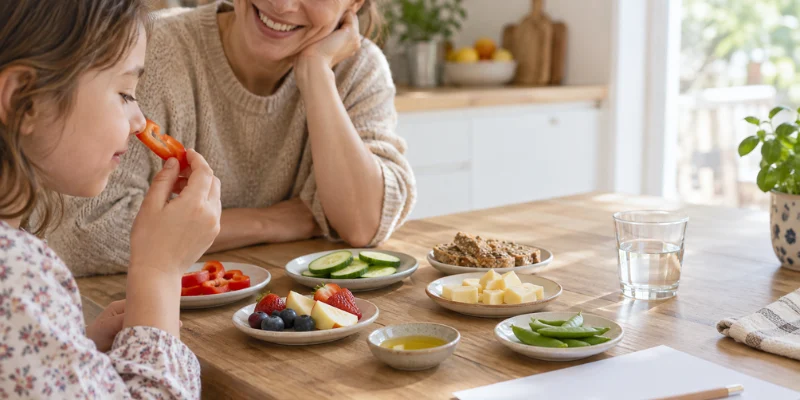
For the game, prepare:
- three to five foods with different flavours, colours and textures
- small plates or bowls
- a blindfold, if the child wants to use one
- paper and a pencil for writing down discoveries
- a glass of water
Choose at least one food that your child already knows and likes, and add a few less familiar ones. These can include different types of fruit and vegetables, cheese, spreads, seeded bread or mild spices.
Adapt the foods to your child’s age and check whether there are any allergies or other dietary restrictions.
How to play “Flavour Detectives”?
Serve each food separately without revealing its name. The child then explores it through several “detective tasks”.
1. Look for visual clues
Start by looking at the food. What colour is it? What shape is it? Is its surface smooth, shiny, wrinkled or speckled?
If you are using a blindfold, you can skip this step and reveal the food only at the end.
2. Explore by touch
Encourage your child to touch the food and describe how it feels. Is it soft or hard, smooth or rough, dry or juicy?
It is important to accept every description. There are no wrong answers in this game.
3. Discover the smell
Bring the food close to the nose and try to describe its smell. Does it remind your child of something they have tasted before? Is the smell mild, fresh, sweet, herbal or intense?
4. Listen to the sound
Some foods can also reveal a lot through their sound. Do they crunch when broken or chewed? Are they quiet and soft? This step can be especially interesting for younger children.
5. Taste a small bite
If your child is ready, offer them a very small piece. Together, try to identify whether the taste is sweet, salty, sour, bitter or a combination of several flavours.
Your child does not have to eat the whole piece. Even touching, smelling or licking the food are valuable steps in becoming familiar with a new food.
Make a detective card
For each food, your child can fill in a simple card:
- Colour:
- Smell:
- Texture:
- Sound:
- Taste:
- What it reminds me of:
- I want to try it again:
Instead of rating foods as “good” or “not good”, offer options such as “I want to try it again”, “I’m not sure yet” and “I don’t like it today”. This leaves room for a child’s experience to change over time.
Why can this game help?
When a new food becomes something to explore, the focus shifts from the question “Will you eat it?” to curiosity and discovery. The child gains a sense of control because they decide how far they want to go – whether they only look at the food, touch it, smell it or taste it.
Children often need several encounters with the same food before they accept it. So do not expect them to enjoy every new flavour after just one game. The important thing is to create a pleasant experience and show them that getting to know food can be fun.
Let your child be the lead detective
In the next round, switch roles. Let your child choose the food, prepare the clues and ask the adults questions. They can also come up with their own categories, such as “the crunchiest clue”, “the strongest smell” or “the biggest surprise”.
This way, the game becomes a shared activity and new flavours become an opportunity for conversation, laughter and learning. The goal is not an empty plate, but for your child to approach new foods with a little more curiosity and confidence.
For more tips, check out our blog, where we regularly cover topics you may find interesting. You can also follow our social media channels, where we regularly share everything you need to know about olive oil.